
How dangerous is Huawei?
Huawei stands for the future. But how close is its connection to the Communist Party? How safe is the data?
Together with a team of colleagues at Handelsblatt, I took a closer look at the Chinese network supplier Huawei. The company's technology is already running inside all three German mobile networks. For the next mobile-phone generation, 5G, Huawei is considered a global leader. But the United States accuses the firm of endangering cybersecurity and being too close to the Chinese government. Is that true? In a video report, Handelsblatt examines the most important questions.
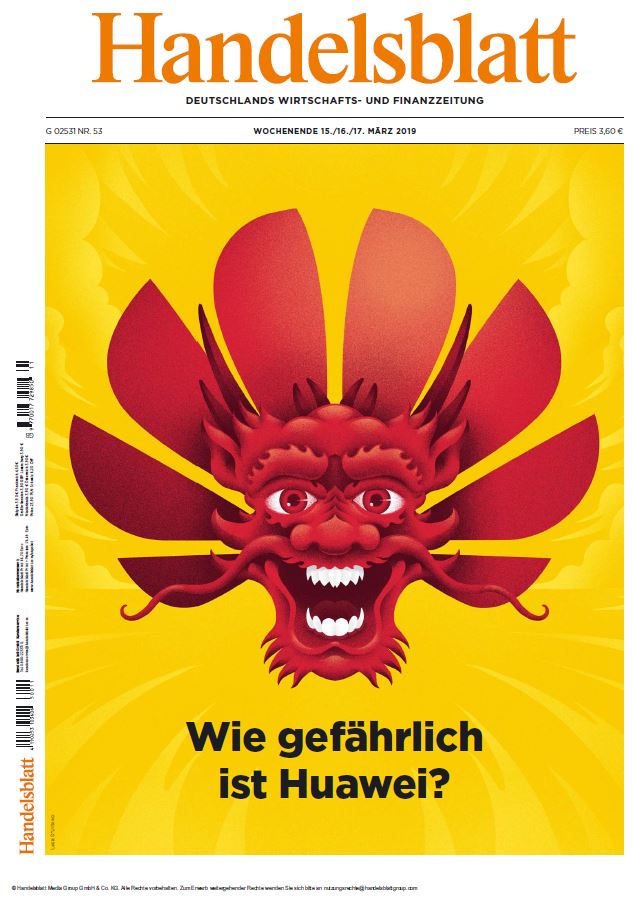
A team of Handelsblatt journalists also spent weeks reconstructing the company's work and history in detail. In China, the United States and Europe, reporters spoke with Huawei employees, government officials and industry experts. The result is a portrait of a digital conglomerate that has grown into one of the most important technology companies of our time – and that finds itself under massive criticism at the same time.
Key findings:
- Founder Ren Zhengfei is the key to understanding the company.
- Huawei grew so large thanks to its business in China.
- Huawei technology is deeply embedded in Germany's infrastructure.
- So far, no backdoors have been found in the company's products.
- Chinese law could compel the firm to cooperate with Beijing's authorities.
You can read the full report here: Handelsblatt report (in German).
Key questions and answers about Huawei

How did Huawei come about?
Huawei was founded in 1987 by Ren Zhengfei, a former engineer in the People's Liberation Army. Ren's vision was to give China modern telecommunications technology and to narrow the digital divide between cities and the countryside. He started Huawei with seed capital of 21,000 yuan (around 2,700 euros) and a team of 14 employees in Shenzhen, a special economic zone in southern China. In the early years, Huawei sold telephone systems to small companies and rural areas in China. Later, Huawei began developing and producing its own products, such as digital switches, mobile networks and optical transmission systems.
Who is Ren Zhengfei?
Ren Zhengfei is the founder and CEO of Huawei. He was born in 1944 into a poor farming family in Guizhou province. He studied at the Chongqing Institute of Civil Engineering and Architecture and joined the People's Liberation Army in 1974, where he was responsible for research and development of military technology. After his discharge from the military in 1983, he worked briefly for a state-owned oil company before founding Huawei in 1987.
What sets Ren Zhengfei apart as an entrepreneur?
Ren Zhengfei is regarded as one of China's most influential entrepreneurs. He has turned Huawei into a global market leader in the ICT industry by building a strong corporate culture grounded in innovation, customer focus and employee participation. Ren is known for his militaristic leadership style. He demands a great deal of his employees. He places great value on training and continuing education and encourages internal competition between different business units. It is unclear how many of Huawei's shares Ren currently holds.
How did Huawei become internationally successful?
Huawei began its international expansion in the 1990s, exporting its products to Russia, South America, Africa and Asia. The company used its cost advantages, its technological expertise and its customer-specific solutions to build a reputation as a reliable and innovative partner for telecommunications operators. Huawei also invested heavily in research and development to strengthen its technological leadership. Today, Huawei runs 28 R&D centres in 17 countries and employs more than 80,000 people in research and development – mostly in China.
What are Huawei's most important products?
Huawei offers a broad portfolio of ICT products and solutions, organised into four main business lines: Carrier Network, Enterprise Business, Consumer Business and Cloud & AI. Huawei was originally focused on products for mobile-network infrastructure. Today the firm also builds smartphones, develops computer chips and offers a number of consumer devices such as fitness bands and tablets.
Why do all three German network operators use Huawei as a supplier?
Huawei is an important partner for the German network operators Deutsche Telekom, Vodafone and Telefónica (O2), all of which use Huawei equipment in their mobile and fixed-line networks. Huawei has become a key partner above all because the firm could offer significantly lower prices than the European competitors Nokia and Ericsson. 5G is supposed to enable higher speeds, lower latency and more capacity, opening up new applications such as autonomous driving, virtual reality and Industry 4.0. Huawei has already set up several 5G test sites in Germany and worked with the network operators.
What is the criticism of Huawei?
Huawei is also under criticism, especially from the United States, which accuses Huawei of being a threat to national security. Washington alleges that Huawei has close ties to the Chinese government and that it could use its products to conduct espionage or sabotage. The US has therefore imposed sanctions on Huawei, prohibiting the company from using American technology or doing business with US firms. The sanctions also affect Huawei's smartphone business, since the company no longer has access to Google services such as the Play Store or Gmail.
What evidence is there for the espionage allegations against Huawei?
US security agencies say that Huawei has covert access to the surveillance interfaces in mobile networks that are actually intended only for law-enforcement authorities. These so-called backdoors could allow Huawei to intercept data or sabotage networks. The US points to classified intelligence as evidence. Publicly available proof of espionage by Huawei is contested. Huawei rejects the allegations and stresses that, as a private company, it is independent of the Chinese government. The firm says it does not build backdoors into its technology and complies with the laws of the countries in which it operates. Huawei has also offered to have its products tested by independent agencies in order to build customer trust.
Why have Huawei employees been convicted in Poland?
In January 2019, a Chinese Huawei sales manager and a Polish cybersecurity expert were arrested in Poland on suspicion of espionage. Prosecutors accuse them of spying on behalf of the Chinese intelligence service; they face up to ten years in prison. The Huawei employee had previously worked at the Chinese consulate in Gdańsk and was responsible for relations with the Polish authorities. The Polish expert was a former senior officer of Poland's domestic intelligence service ABW. The arrests led to searches of Huawei's offices in Poland. Huawei dismissed the Chinese employee after his arrest and stresses that the allegations have nothing to do with the company.
What is the legal situation for Huawei in China? Is the firm obliged to cooperate with Chinese security authorities?
Companies in China are subject to the government, or rather the Communist Party. In recent years, the state has massively expanded the access of security authorities in the country. Huawei is also subject to these rules. Among other things, China has tightened its cybersecurity laws, which require, among other things, that internet providers hand over user data to the state in case of doubt. China has also enacted a National Security Law that provides for far-reaching powers to combat threats to national security. These laws could also be applied to Huawei if the government considers it necessary.
Countries such as Sweden have banned Huawei from their 5G networks. Why?
Huawei is one of the leading providers of 5G technology, which enables faster and more reliable data transmission. However, some countries fear that Huawei could use its 5G equipment for espionage or sabotage by building in backdoors for access by the Chinese government, or by shutting down the networks during a conflict. These fears are reinforced by the Chinese law that requires all companies to cooperate with the security authorities. The United States has long excluded Huawei from its 5G networks and has urged other countries such as the United Kingdom, Japan, Australia and New Zealand to do the same. In October 2020 Sweden likewise announced a ban on Huawei and another Chinese provider, ZTE, from its 5G network, to be implemented by 2025. Sweden cited national security and the protection of its citizens as the reason for its decision.
What role does Germany play in the dispute over Huawei?
Germany is one of the most important markets for Huawei in Europe and a strategic partner for the 5G rollout. Huawei has worked for years with German telecoms providers such as Deutsche Telekom, Vodafone and Telefónica, and has several research and development centres in Germany. At the same time, Germany is also under pressure from its allies, especially the United States, to exclude Huawei from its 5G network. The federal government has so far not imposed a blanket ban on Huawei, opting instead for a risk-based approach that calls for a careful review of suppliers. In December 2020 the Bundestag passed a new IT security law that imposes stricter requirements on the security and transparency of telecommunications equipment suppliers.