
This Website Was Built With AI — And It Changed How I Think About Software
How I rebuilt my site from WordPress to Astro with AI support, LinkedIn data exports, and GitHub deployments — including practical lessons on SEO, speed, and infrastructure.
From WordPress to Astro, from LinkedIn data exports to GitHub deployments: why I rebuilt my entire website infrastructure, how AI became part of the process — and why the reality was far messier than most AI demos on the internet suggest.
I’ve been building websites since I was in school. Back then, it meant hand-editing HTML files, experimenting with layouts, and trying to understand why things looked completely different in the browser than they did in my head. A lot of it was improvised. But that mix of writing, design, and technical tinkering never really left me.
My perspective on technology changed fundamentally in 2020, when I moved to San Francisco as a correspondent. I arrived at a moment when Silicon Valley was rapidly reshaping itself: the pandemic, remote work, new platform dynamics — and then, in November 2022, the launch of ChatGPT.
Even at the time, it was obvious that something important was happening.
I started experimenting heavily with AI tools. Some were genuinely impressive. Many were overhyped.
But nothing felt as transformative to me as the leap that happened in late 2025 and early 2026.
The latest models from OpenAI and Anthropic reached a level where software development suddenly started to feel fundamentally different — not just for professional engineers, but also for people like me who are technical but not full-time software developers. In 2026 so far, there has barely been a day when I haven’t used AI to write, modify, debug, or rethink code.
At some point, that naturally led to another idea:
Why not rebuild my entire website from scratch?
Why I Wanted to Leave WordPress Behind
The previous version of my site was built on WordPress. It worked. But I was never really happy with it.
If you want an impression of the old version, you can still find it in the Internet Archive’s Wayback Machine: Open the old site in the Wayback Machine.
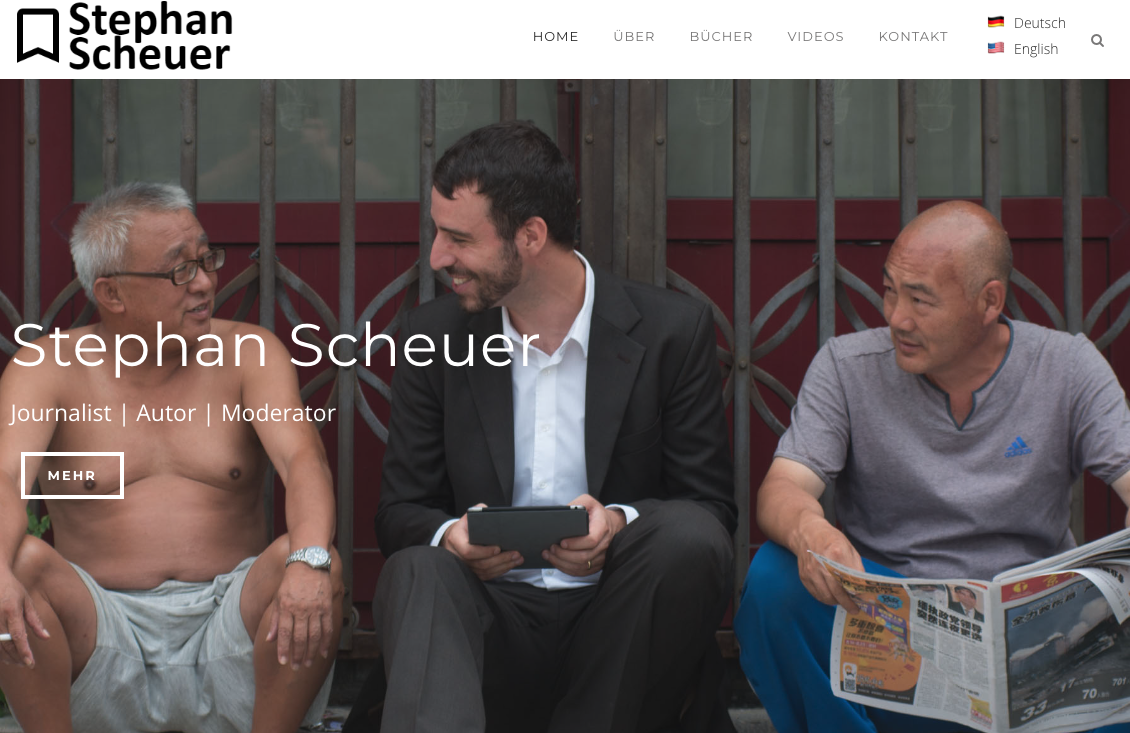 The previous WordPress-based version of stephanscheuer.de.
WordPress is incredibly powerful. That gradually became the problem.
I don’t need comment systems. I don’t need complex user management. I don’t need a massive CMS backend. I’d rather write directly in Markdown or HTML files than manage everything through admin dashboards.
At the same time, WordPress carries a huge amount of technical overhead that I simply wasn’t using.
The biggest frustration was multilingual support. Over the years, I tried multiple commercial solutions to manage German and English content cleanly. Some plugins disappeared entirely. Others stopped being maintained. And many never felt elegant in the first place.
Then there were the security issues.
Over time, I had integrated all kinds of external services and plugins into the site. Some worked fine. Others absolutely did not. At one point, mistakes by external vendors introduced real security vulnerabilities into my website. That was one of the moments when I realized how dependent I had become on an increasingly fragile stack of third-party tools.
Meanwhile, the actual vision for the site had evolved far beyond what WordPress was built for.
Much of my work focuses on the United States, but also on China. For years, I had wanted a platform that could eventually bring together content across multiple languages — at least German and English, and maybe eventually Chinese as well.
There was also another issue: LinkedIn.
For roughly eight years, I had been posting observations, analysis, ideas, and personal notes there on a regular basis. Over time, that created a surprisingly large archive of material — but one that was practically invisible. Posts disappear into the feed. They’re difficult to structure or rediscover. And ultimately, they belong to a platform, not to me.
By 2026, the idea of rebuilding everything from scratch started to make sense.
The Rebuild: Why I Chose Astro
The first question was simple:
If you were building a modern personal website from zero today, what would the architecture actually look like?
I quickly landed on Astro.
Astro is a modern web framework focused on static delivery. In simple terms: much of the website is pre-generated before visitors ever load the page. That dramatically improves speed and reduces complexity.
It fit exactly what I wanted.
I wanted to use as little JavaScript as possible — only where it genuinely added value. I also wanted to minimize PHP usage, limiting it mostly to things like contact forms or future newsletter functionality.
Most of the site should simply be fast, lightweight HTML.
Astro turned out to be ideal for that.
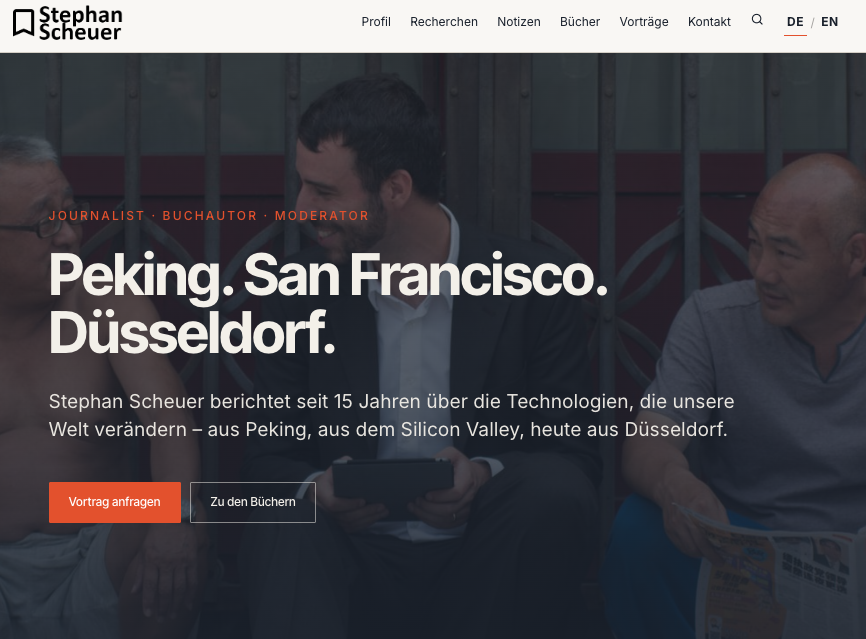
The redesigned Astro-based version of stephanscheuer.de.
The large hero image intentionally stayed in place for visual continuity, but the architecture behind the site is now completely different.
That said, this approach also comes with trade-offs.
In a traditional CMS, you can often fix a typo directly in the browser within seconds. With my current setup, even small edits are much more technical. Changes go through GitHub, trigger builds, and then need to be redeployed to the server. Often, much more gets rebuilt than the tiny thing you actually wanted to fix.
The result is more robust — but not necessarily more convenient.
How AI Actually Helped Build the Site
Most of the site was built in Visual Studio Code. The AI tools I relied on most heavily were OpenAI’s Codex and Claude models from Anthropic.
And for the first time, AI genuinely started to feel less like an autocomplete tool and more like a development partner.
The models could debug deployment issues, reason through routing problems, suggest architecture decisions, and analyze codebases surprisingly effectively.
But they also failed. Frequently.
Longer development sessions quickly exposed the limits of current AI systems.
The models regularly hallucinated functions that didn’t exist. Sometimes they made perfectly working code worse. At other times, files or configurations effectively disappeared because the AI suggested the wrong changes. More than once, I had to roll back large sections of work or manually reconstruct broken files.
The infrastructure of the AI companies themselves also became part of the workflow.
Anthropic experienced outages and severe slowdowns multiple times while I was actively working. In practice, that meant parts of the development process suddenly stalled. Switching back and forth between Anthropic and OpenAI also introduced friction. Moving a complex project between models often meant losing technical context, assumptions, or architectural continuity.
That part surprised me more than expected.
The GitHub history of the project reflects this highly iterative process pretty clearly.
The redesign officially started on April 21, 2026. Over the following weeks, the site went through constant cycles of restructuring, debugging, SEO fixes, multilingual routing, image optimization, deployment failures, and infrastructure hardening.
Ironically, the hardest part wasn’t the design.
The real complexity lived underneath:
- preserving redirects from old WordPress URLs,
- maintaining SEO continuity,
- stabilizing deployments,
- implementing incremental updates,
- handling multilingual routing,
- and preventing broken links.
Today, the entire site is version-controlled through GitHub. Changes are automatically built and deployed via FTPS to my hosting provider. Cloudflare sits in front of the site for caching and security.
The overall infrastructure is intentionally minimal.
And honestly, that now feels like one of the biggest advantages of the entire rebuild.
The Most Important Part: My LinkedIn Archive
The real content backbone of the new site came from an unusual source.
I submitted a GDPR data request to LinkedIn and exported the complete archive of my account data. The result was a huge collection of CSV files containing posts, metadata, and references to images.
The problem: the images themselves weren’t included — only URLs pointing to them.
So, with the help of AI, I built a small scraper that automatically downloaded and archived the images. Only then did it become possible to systematically rebuild and curate the material.
That’s when the editorial work started.
I selected the most relevant LinkedIn posts from recent years and connected them to related Handelsblatt reporting. The site now includes introductions and excerpts from those stories, with links back to the original Handelsblatt articles.
For copyright reasons, I can’t republish full articles independently. But the excerpts provide context and allow readers to continue directly to the original reporting.
Why the New Site Structure Looks Different
The original version of the website launched in 2018, mainly as a companion platform for my first book.
A lot has changed since then.
I returned from China to Germany. Later moved to San Francisco as a correspondent. Then back to Germany again. I wrote another book. My reporting increasingly expanded into AI, geopolitics, telecom, platforms, and technology policy.
The website needed to reflect that evolution.
Today, the site is organized into several layers:
- books,
- reporting and longform stories,
- speaking engagements,
- and a new section called “Notes.”
You can browse these sections directly: Books, Stories, Speaking, and Notes.
That last section was especially important to me.
Not everything interesting fits neatly into traditional journalism formats. Some thoughts are more experimental, technical, or personal. The new Notes section creates space for that.
At the same time, the site has become much larger than before. Nearly all major pieces now also exist in English versions. But these are not simple translations. I wanted the English content to feel native to an international audience — with different framing, different context, and sometimes different emphasis entirely.
That also makes maintenance significantly harder.
The more versions, languages, and content layers you create, the more difficult it becomes to immediately spot mistakes. Some issues only appear much later. And multilingual publishing effectively multiplies every small maintenance task.
Speed Instead of Technical Bloat
One of the biggest lessons from the project is that modern websites do not have to be heavy.
The new site loads extremely fast. Images are aggressively optimized. Most content is statically delivered. Runtime overhead is minimal.
Additional tools are only used where they genuinely make sense. For example, I use Pannellum — a specialized panorama viewer — for the 360-degree photography from my North Korea project. Beyond that, I try to keep external dependencies to an absolute minimum.
The same philosophy shaped the newsletter infrastructure, including double opt-in workflows and EU privacy requirements.
Overall, the site now feels far more controllable than before.
Fewer external services. Fewer unnecessary plugins. Far less attack surface.
What I Learned From This Project
The most important lesson surprisingly has very little to do with code itself.
AI does not replace ideas. And it certainly does not replace understanding how systems work.
But it dramatically changes who is capable of building sophisticated software projects.
Things that once required agencies, large teams, or dedicated engineering resources can increasingly be developed iteratively by individuals — if they are willing to deeply engage with the process.
At the same time, the limitations are very real.
AI accelerates development, but it also produces hallucinations, broken logic, and genuinely bad code. You still need to verify, test, debug, and understand what is actually happening. Blind trust — especially around infrastructure, security, or SEO — would be reckless.
Still, the overall shift feels fundamental.
Not because AI can suddenly “do everything.”
But because the distance between an idea and working software has become dramatically smaller.
And that is why this website ultimately became more than a redesign project.
It turned into an experiment in how journalism, creativity, and software development are beginning to converge in the age of AI.